It's the first question every homeowner asks and the one most contractors dodge: what is this floor going to cost? We'd rather give you an honest framework than a mystery number. Here's what actually drives the price of a professionally installed epoxy or polyaspartic floor in the Lehigh Valley — and how to tell a real quote from a cheap one.
The honest answer: it depends on the slab
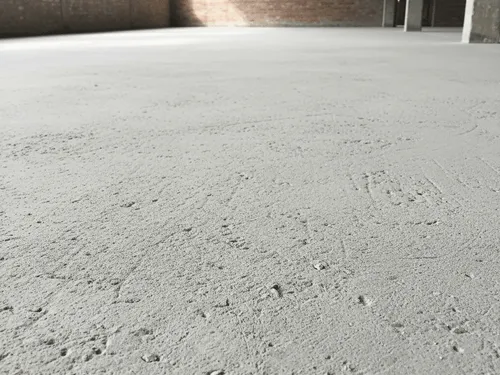
Two identical-looking two-car garages can get very different quotes, and the difference is almost never the coating — it's the concrete underneath it. The floor is priced by condition, square footage, and the system you choose. A clean, sound slab that just needs grinding takes the standard prep. A slab with cracks, spalling, oil saturation, or moisture needs patching, leveling, or mitigation before any coating goes down.
That's why a legitimate contractor prices after seeing the floor, not over the phone. Anyone who quotes you a firm number without inspecting the slab is guessing — and you'll pay for that guess later.
What you're actually paying for
A professional floor breaks down into four parts: surface preparation, materials, labor, and the system itself. Prep — mechanical diamond grinding, patching, and moisture testing — is typically the largest and most important line. It's also the one cheap quotes cut first.
Materials matter too. A 100%-solids industrial epoxy with a polyaspartic topcoat costs more per gallon than the water-based kits sold at big-box stores — several times more. But the kit covers one thin coat that peels in two to five years, while the professional system is built to last fifteen to twenty-plus. Spread over its life, the professional floor is the cheaper floor.
How the system you choose moves the price
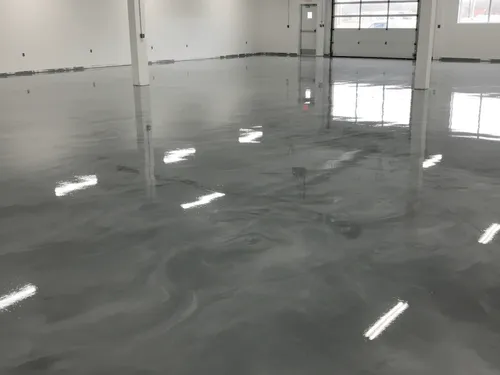
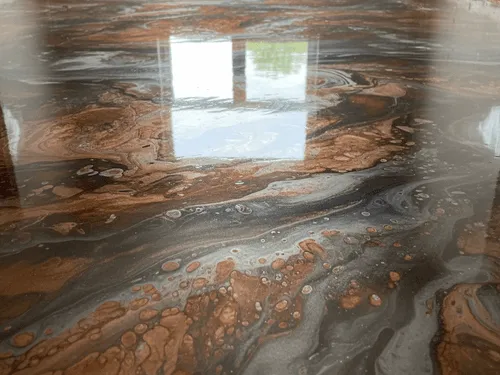
Each finish carries a different material and labor cost. Solid color epoxy is typically the most economical. Flake systems add the broadcast and lock-in steps. Metallic floors take the most hands-on artistry, since the pigment is worked by hand. Quartz and high-build systems add material thickness for the toughest environments.
The good news: hundreds of flake and metallic color combinations exist within each system, so you can usually land on a look you love at the price point that fits. That's exactly what we walk through during the free estimate — matching the finish to the space and the budget, not upselling.
Why the cheapest quote usually isn't
The low bid almost always wins by removing prep, thinning the coating, or skipping moisture testing. Those cuts are invisible on install day and catastrophic by year three, when the floor starts peeling and there's no warranty behind it. Grinding a failed floor off and starting over costs far more than doing it right the first time.
When you compare quotes, ask three questions: Will you mechanically grind the slab? Do you moisture-test before coating? What exactly does the warranty cover, and for how long? A contractor who answers all three confidently is pricing a floor that lasts. One who dodges them is pricing a floor that fails.
Getting a real number for your floor
Every Groundform estimate is free, with no obligation, and most come back within one business day. We inspect the slab, test for moisture where it matters, talk through the finish you want, and give you a detailed written quote — so you know exactly what you're paying for before you decide.
We also back every installed floor with a 10-year warranty, and financing is available if you'd rather spread the investment out. If you're curious what your garage, basement, or commercial space would run, the fastest path is a free quote — it costs nothing and it's the only number that's actually about your floor.
Want this kind of floor in your space? We install across the Lehigh Valley with a 10-year warranty and free estimates — usually back to you within one business day.