If you're coating a garage floor in the Lehigh Valley, the question isn't really epoxy or polyaspartic. It's which combination of the two will survive Pennsylvania winters, hot tires, road salt, and the way you actually use your space. Here's the honest breakdown we give every homeowner on a free estimate.
What epoxy does best
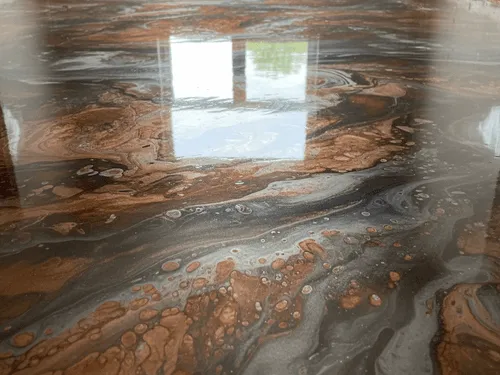
Epoxy is a proven, high-build resin that bonds deep into properly profiled concrete. That deep bond is what lets us broadcast flake, trowel metallic pigment, and build the thick wear surface a garage actually needs. Epoxy carries the decorative finishes — it's the workhorse underneath the beauty.
Its weakness is UV. Standard epoxy can amber or yellow in direct sunlight, and it can soften under hot tires pulled in off a summer drive. On its own, that's why a bare epoxy garage floor can start to show tire marks or peel under the tires after a few seasons.
What polyaspartic does best
Polyaspartic is a newer-generation resin that solves exactly those two weaknesses. It's UV-stable, so it won't yellow in a sunlit garage, and it resists hot-tire pickup — the leading cause of epoxy peeling. It also cures in hours instead of days, so you can often park on it the next morning.
Where epoxy bonds deep and carries finish, polyaspartic protects the surface and flexes with seasonal slab movement without cracking. It's the better topcoat for any space that sees sun or vehicles.
Why we usually use both
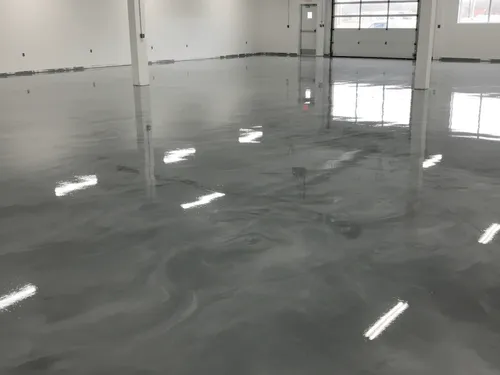
Our recommended residential garage build is a hybrid: a 100%-solids epoxy base for bond and decorative finish, topped with a UV-stable polyaspartic clear coat. You get the depth and adhesion of epoxy where it matters and the UV and hot-tire resistance of polyaspartic where the floor takes a beating.
It costs a little more than a bare epoxy floor, but it's the system that lasts 15 to 20-plus years instead of peeling in three to five. Given what it costs to redo a failed floor, the hybrid pays for itself the first time it survives a winter the cheaper floor wouldn't.
How we decide on your estimate
The right answer depends on your slab, your light, and your use. A dark, below-grade basement doesn't need the same UV protection as a south-facing garage. A showroom garage that gets driven into daily needs the polyaspartic topcoat; a storage garage that rarely sees a hot tire may not.
We test the slab for moisture, look at how the space is used, and recommend the system that will actually last — not the one that's easiest to sell. That's what our 10-year warranty is built on.
Want this kind of floor in your space? We install across the Lehigh Valley with a 10-year warranty and free estimates — usually back to you within one business day.