A basement is the single hardest place to install epoxy. The slab is below grade, the ground around it is constantly wet, and Pennsylvania's freeze-thaw cycles push moisture vapor up through the concrete. Skip the prep and your new floor peels within a year. Here's the process we follow on every basement in the Lehigh Valley.
Test for moisture first, always
Concrete is porous, and a basement slab can look perfectly dry on the surface while transmitting serious moisture vapor from below. We test every basement floor with calcium chloride or relative-humidity probes before we coat it. If the readings exceed the threshold for the system you've chosen, mitigation isn't optional — it's the difference between a floor that lasts decades and one that blisters and delaminates.
This is the step DIY kits and low-bid contractors skip, and it's the number one reason basement epoxy fails. Test, don't guess.
Install a moisture mitigation system when readings are high
When the slab reads high, we install a specialized moisture mitigation primer or membrane before any decorative coating. It blocks vapor transmission, accommodates the natural movement of the concrete, and creates a stable bond for the epoxy, flake, or metallic system that follows.
It adds a day and a modest cost, but it's a fraction of what it costs to grind a failed floor off and start over. On basements, we'd rather do it right once.
Mechanically profile the slab
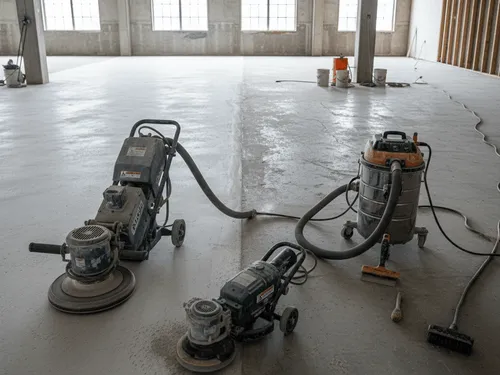
We never rely on acid etching. We mechanically diamond-grind the basement slab to open the concrete's pores and create the texture the coating needs to mechanically lock on. Grinding also removes old sealers, paint, adhesive, and laitance that would block adhesion.
A coating is only as durable as its bond to the concrete, and that bond depends entirely on a properly profiled, clean substrate.
Patch, then build the system
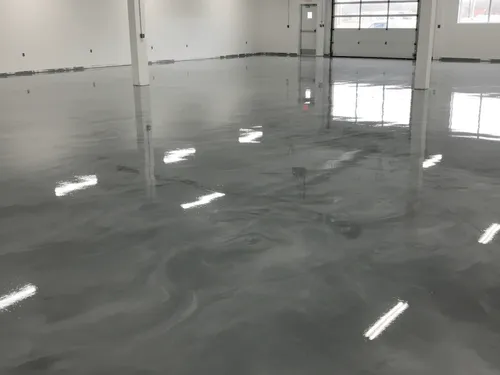
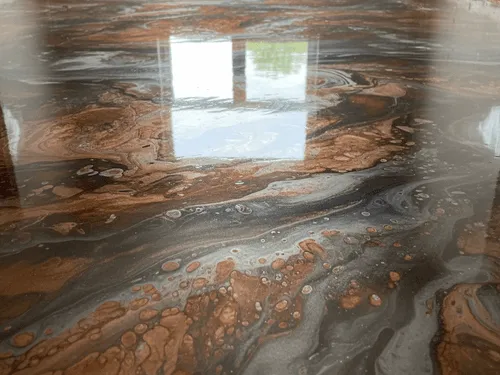
Cracks, spalls, and joints get patched and leveled so the finished floor is seamless. Then we lay the system you chose — a warm brown-on-brown metallic for a man cave, a flake broadcast for a rec room, or a solid color for a clean utility look — and top it with a protective clear coat matched to the space.
Done this way, a basement floor becomes the easiest-to-clean, most moisture-resistant surface in the house. It's the difference between a basement that still feels like a basement and one that feels like a finished room.
Want this kind of floor in your space? We install across the Lehigh Valley with a 10-year warranty and free estimates — usually back to you within one business day.