When an epoxy floor peels, the coating gets the blame. Nine times out of ten, the coating did exactly what it was supposed to — the concrete underneath wasn't prepared for it to bond. Here are the four reasons epoxy floors fail, and why a properly prepared floor simply doesn't.
1. Poor surface preparation
This is the cause behind almost every peeling floor we're called in to fix. Epoxy bonds mechanically to the concrete, and it needs an open, profiled surface to grab hold of. Acid etching alone leaves an inconsistent profile and residue behind; a slick, un-ground slab gives the coating nothing to lock into.
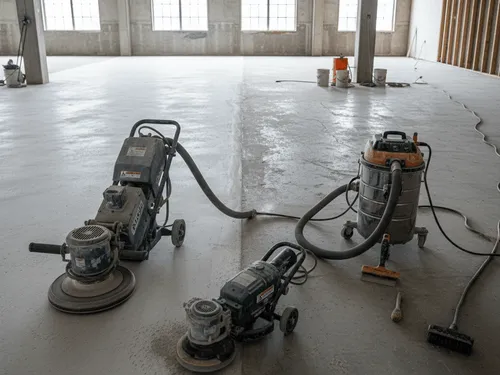
We mechanically diamond-grind every slab to open the pores and create a uniform texture. It's slower and more work than a quick acid wash, but it's the foundation of a floor that lasts 15 to 20-plus years instead of 3 to 5.
2. Moisture vapor from below
Concrete breathes. Moisture vapor moves up through the slab, and if it can't escape it lifts the coating off the surface — blistering, bubbling, and eventually peeling. It's especially common in basements, older slabs, and any floor without a vapor barrier.
We test for moisture before we coat and install a mitigation system when readings are high. The coating goes down over a barrier, not over a slab that's quietly pushing water at it.
3. Hot-tire pickup
Tires come in hot off a summer drive, and standard epoxy can soften under that heat. The next time the car moves, it lifts the coating with it — that's hot-tire pickup, and it's why bare epoxy garages peel under the tires.
We topcoat garage and patio systems with a UV-stable polyaspartic that resists hot-tire pickup. The epoxy bonds and carries the finish; the polyaspartic protects it.
4. UV yellowing and breakdown
Standard epoxy ambers and breaks down in direct sunlight. A sunlit garage or a patio in full sun will yellow and eventually chalk. It's not a defect — it's just not the right material for the exposure.
The fix is a UV-stable topcoat for any floor that sees sun. We match the topcoat to the space, so the floor you love on day one is the floor you still have in year ten.
The common thread
Every one of these failures traces back to prep — or the lack of it. A properly profiled, moisture-tested, and topcoated floor doesn't peel because it was built to bond and built to last. That's what our 10-year warranty stands behind, and it's the difference between a floor that's cheap up front and one that's actually worth what it costs.
Want this kind of floor in your space? We install across the Lehigh Valley with a 10-year warranty and free estimates — usually back to you within one business day.